System of Radiation, Chemical, Biological Reconnaissance

SRCBR-T

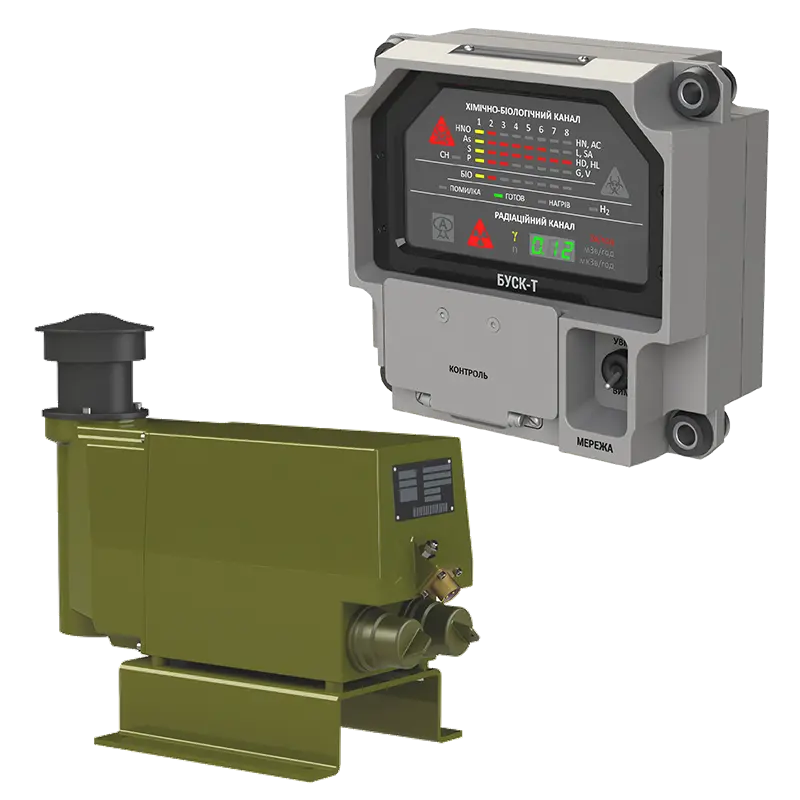
The system is designed for conducting radiation, chemical, and biological reconnaissance. It is installed on CBR reconnaissance vehicles and consists of:

  • BUSK-T control, alarm, and monitoring unit, which is placed inside the vehicle
  • AP4C-VB chemical and biological reconnaissance device, which is mounted outside

To obtain information about our products during the preparation of tender or contractual documentation, please contact our representatives via the provided contacts. We continuously improve our products and expand their functionality in line with market needs by applying the latest technologies, modern components, and materials. Therefore, specifications, descriptions, and configurations are subject to change without prior notice.

Features

  • Capability to detect in the air all known chemical warfare agents (CWAs) of nerve-paralytic, blister, general toxic, and certain choking types, as well as highly toxic substances containing sulfur, arsenic, phosphorus, ammonia, hydrogen sulfide, nitric acid vapors, etc.
  • Powered from the vehicle’s onboard network
  • Capability to detect biological agents:
    • Bacteria – anthrax, plague, tularemia, brucellosis, typhus, cholera, glanders
    • Viruses – smallpox, hemorrhagic fevers (Ebola, Marburg), arenaviruses (Lassa, Machupo), viral encephalitis
    • Toxins – botulism, ricin toxin, staphylococcal enterotoxin
  • Operating principle based on flame spectrometry technology, which ensures reliable performance under any environmental influence and provides the following advantages:
    • No limitations on the number of detectable molecular types
    • No need for inlet filters or membranes, eliminating clogging risks
    • Capability to detect mixed products, unrefined substances, precursors, derivatives, and unknown compounds
    • Very short recovery time after confirmed detection
    • Insensitivity to external factors (dust, high humidity, diesel exhaust gases, etc.)
    • Lowest false alarm rate compared to other technologies

Thanks to flame spectrometry technology, the device is the only detector that meets NATO’s recommended requirements for sensitivity, detection time, and recovery time.

Additionally, we offer the CRHR-T system, which is similar in purpose but does not provide biological reconnaissance capability.


BUSK-T control, alarm, and monitoring unit

  • Collection, processing, and visualization of information received from the AP4C-VB chemical and biological reconnaissance device
  • Continuous measurement of gamma radiation equivalent dose rate
  • Registration of a nuclear explosion event
  • Transmission of measurement results to the data collection and processing system
  • Activation of audible and visual alarms in case of dangerous levels of gamma radiation or chemical/biological threats
  • Generation and transmission of commands (“R”, “A”, “O”, “BORA”) to the control unit of the crew protection system actuators

AP4C-VB chemical and biological reconnaissance device

  • Continuous automatic monitoring of ambient air to detect the presence of chemical warfare agents, biological agents, and toxic industrial substances
  • Determination of classes and concentrations of warfare agents and toxic industrial chemicals in air
  • Transmission of information to the BUSK-T unit

Delivery kit

  • BUSK-T unit
  • AP4C-VB device
  • logbook (Formulary)
  • AP4C-VB Instruction Manual
  • set of tools and accessories
  • set of mounting parts
  • technological and metrological equipment
  • operating Manual
  • packaging*

* Alternative packaging may be used as specified in the supply contract

Specifications
BUSK-T main technical specifications
Measurement range of gamma radiation dose equivalent rate
0.01 µsv/h ... 10 sv/h
Registered gamma radiation energy range
0.06 ... 1.25 MeV
Main relative permissible error limit when measuring gamma radiation dose equivalent rate (for 137Cs), with a confidence probability of 0.95, does not exceed
±(15+2/h(10)) %, where h(10) is the numerical value of the measured ambient dose equivalent rate in µsv/h
Energy dependence of measurement results when measuring gamma radiation in the energy range from 0.66 mev to 1.25 mev, does not exceed
±25 %
Complementary permissible error limit when measuring gamma radiation dose equivalent rate caused by ambient temperature variation in the range from -30 ºc to +50 ºc, does not exceed
5% for every 10 ºC deviation from 20 ºC
The system is powered from the onboard direct current network
12 ... 28.5 V
Current consumption at nominal supply voltage of 24 v, not more than
6 A
Continuous operating time, not less than
24 h, with subsequent shutdown not exceeding 1 h
Digital interface for data exchange with the ap4c-vb device and the onboard computer
RS-485
Overall dimensions of the unit, not more than
190 х 180 х 90 mm
Weight of the unit, not exceeding
2.5 kg
AP4C-VB main technical specifications
Detection of vapors of toxic substances and aerosols of biological agents with concentrations exceeding the threshold value:
- for S (sulfur)
0.150 mg/m³
- for P (phosphorus)
0.004 mg/m³
- for As (arsenic)
1 mg/m³
- for HNO
4 mg/m³
- for biological agents
30 equAcpla/min
Sizes of biological agents detected by the detector
2 ... 10 µm
Overall dimensions, not more than
350 х 175 х 280 mm
Weight
5 kg
Overall dimensions of the system in packaging, not more than
790 х 500 х 290 mm
Weight of the system in packaging, not exceeding
30 kg
Support

Your order

SRCBR-T System of Radiation, Chemical, Biological Reconnaissance
Number of units:
Feedback:

Ask a question

Feedback: